If you are asking, “Do I need VAT registration in UAE?”, start with these 5 facts:
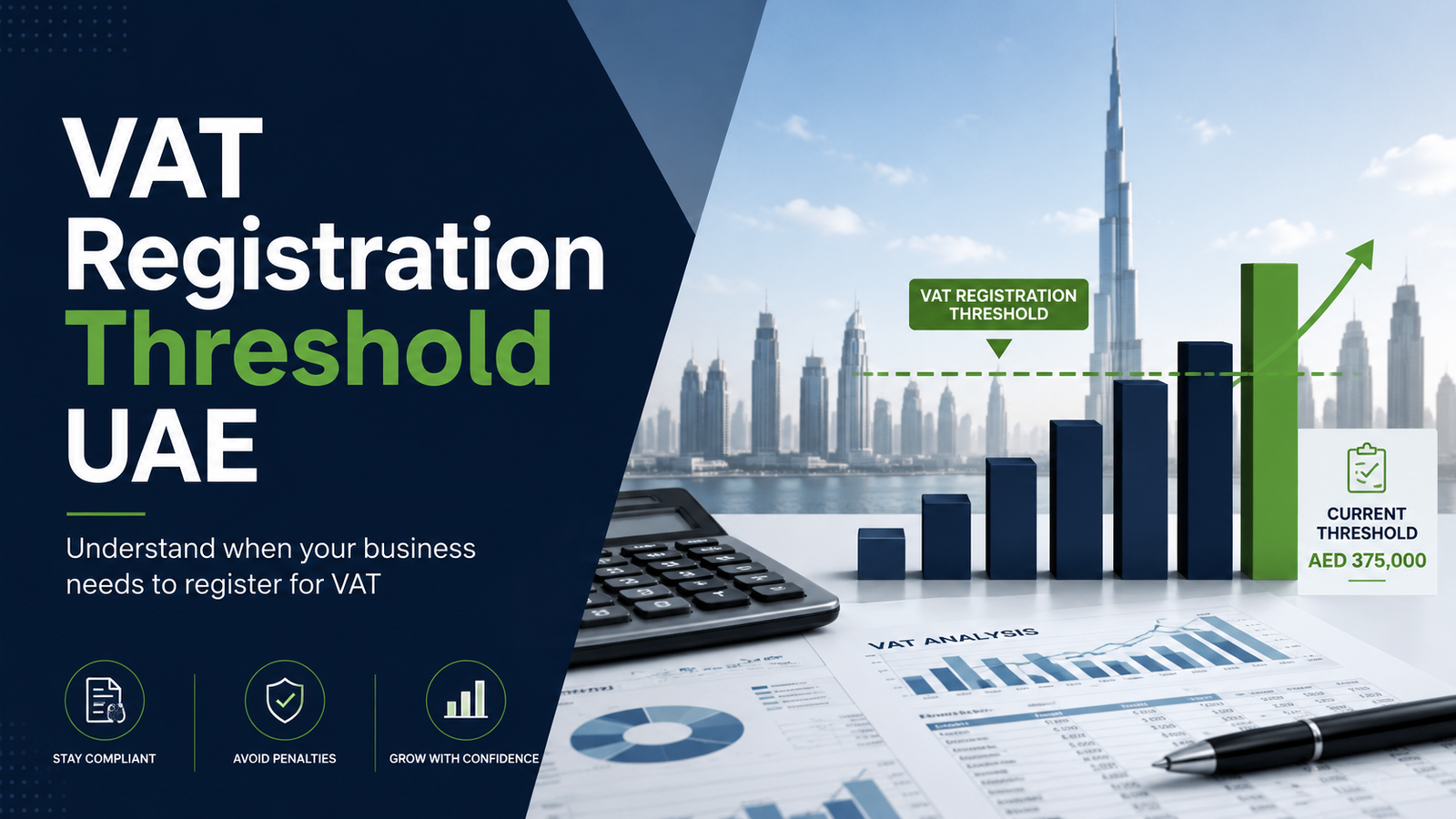
- Mandatory VAT registration threshold UAE: AED 375,000.
- Voluntary VAT registration threshold UAE: AED 187,500.
- The test is based on taxable supplies and imports. For voluntary registration, taxable expenses can also qualify.
- If you are required to register, the FTA says you must apply within 30 days.
Many UAE businesses get this wrong because they:
- Look at profit instead of taxable turnover.
- Ignore imports.
- Miss the next 30 days test.
- Assume free zone means no VAT review is needed.
This guide explains the VAT threshold UAE 2026, who must register, how the FTA VAT registration UAE process works, what documents you need, and how to avoid costly mistakes.
What is VAT Registration in the UAE?
VAT registration in the UAE is the process of registering your business with the Federal Tax Authority (FTA) so you can obtain a tax registration number and meet your VAT obligations. The UAE applies VAT at a standard rate of 5%, and VAT is charged through the supply chain while the final consumer bears the cost.
In practical terms, VAT registration means your business may need to:
- Charge VAT on taxable supplies where required.
- Issue valid VAT invoices
- File VAT returns.
- Pay VAT due to the FTA.
- Recover eligible input VAT on business expenses, subject to the rules.
- Keep accurate financial records that support your VAT position.
A simple rule to remember:
VAT registration threshold is about taxable turnover, not net profit. The official threshold test looks at taxable supplies and imports and, for voluntary registration, can also look at taxable expenses.
VAT Registration Threshold in UAE
- Mandatory VAT registration UAE: AED 375,000.
- Voluntary VAT registration UAE: AED 187,500.
- Check both the last 12 months and the next 30 days.
- The threshold looks at taxable supplies and imports; voluntary registration can also use taxable expenses.
Mandatory Registration Threshold
A UAE-resident business must complete mandatory VAT registration in the UAE if:
- Its taxable supplies and imports exceeded AED 375,000 in the previous 12 months.
- It expects taxable supplies and imports to exceed AED 375,000 in the next 30 days.
Voluntary Registration Threshold
A business may choose voluntary VAT registration in the UAE if it does not meet the mandatory test, but:
- Its taxable supplies, imports, or taxable expenses exceeded AED 187,500 in the previous 12 months.
- It expects taxable supplies, imports, or taxable expenses to exceed AED 187,500 in the next 30 days.
Important Threshold Note
Do not confuse:
- Revenue with profit
- Taxable supplies with exempt income
- Past 12 months with future 30-day projection
That confusion is one of the biggest reasons businesses miss the VAT registration limit UAE.
Who Must Register for VAT?
You should review your VAT position immediately if you are any of the following:
- A mainland company close to or above the threshold.
- A freelancer or sole establishment with growing turnover.
- An e-commerce seller importing goods into the UAE.
- A consultant or agency with new contracts.
- A startup with high taxable setup expenses.
- A non-resident business making taxable supplies in the UAE.
- A free zone company that assumes VAT does not apply automatically.
Officially, the FTA says:
- Resident businesses must register when they exceed AED 375,000 in taxable supplies and imports over the last 12 months, or expect to exceed it in the next 30 days.
- Non-resident businesses must register if they make taxable supplies in the UAE, even if they do not exceed the threshold, unless another party in the UAE is responsible for settling the VAT on those supplies.
- VAT registration rules apply to natural persons and legal persons conducting business in the UAE, even if the person has no trade license.
Free Zone Businesses: Important Note
Free zone status does not automatically remove VAT obligations. The FTA has clarified that certain supplies of goods in a Designated Zone may be outside the scope of VAT only under specific conditions. That is a technical rule, not a blanket exemption for every free zone business.
Benefits of VAT Registration
VAT registration is not only about avoiding penalties. It can also create practical business benefits.
Key Benefits
- Avoid the AED 10,000 late registration penalty.
- Recover eligible input VAT on business expenses that relate to taxable supplies.
- Register voluntarily on expenses if you are a startup with high setup costs and low or zero turnover.
- Build cleaner records and reporting discipline, because VAT-registered businesses must maintain proper commercial records and report VAT regularly.
- Get your VAT certificate and tax registration number through the FTA once your application is approved.
For many SMEs, startups, consultants, and online sellers, voluntary registration can be commercially useful when they want to recover input VAT early and build better compliance systems from day one.
Documents Required for VAT Registration
The FTA says document requirements vary based on whether the applicant is a natural person or legal person. In most cases, businesses should prepare the following before starting the FTA VAT registration process UAE 2026:
Core Documents
- Certificate of Incorporation, Memorandum of Association, or Partnership Agreement, if applicable.
- Commercial registration certificate or other official document from the licensing authority.
- Valid trade license and branch licenses, if any
- Emirates ID and passport of owners and authorized signatories.
- Power of attorney, where required for the authorized signatory.
Financial and Supporting Evidence
- Official declaration letter stating total taxable supplies and monthly sales from establishment to application date, stamped and signed
- Supporting invoices
- Local purchase orders
- Contracts
- Ownership deeds
- Completion certificates
- Lease agreements
- Customs information, if available
Extra Evidence for Voluntary or Forward-Looking Cases
- If applying based on expenses: at least five VAT invoices with amounts exceeding the threshold.
- If applying based on expected revenue: valid purchase orders or contracts, stamped and signed by both parties.
- Optional bank letter showing account information
Useful Filing Tip
- The FTA service page accepts PDF and DOC files.
- Maximum file size per document is 15 MB.
Step-by-Step VAT Registration Process
The official VAT registration process UAE through the FTA is straightforward, but many applications fail because businesses calculate the threshold incorrectly or upload weak documents.
FTA VAT Registration Process UAE 2026
- Sign up for an Emara Tax account and activate it.
- Access the Emara Tax dashboard.
- Create a new Taxable Person Profile.
- Open the Taxable Person Account.
- Click Register under Value Added Tax.
- Complete the application and upload supporting documents.
- Submit the application.
- Once approved, download the VAT registration certificate from your dashboard.
Official Time Estimates
- Estimated time to submit the application: 45 minutes
- Estimated FTA completion time after receiving a completed application: 20 business days.
Practical Tip
Before you submit:
- Recheck your threshold calculation.
- Make sure turnover numbers match your supporting evidence.
- Keep imports, expenses, and projected sales evidence ready.
- Ensure names, IDs, and licenses are consistent across documents.
This simple review step often prevents avoidable delays.
VAT Registration Fees in UAE
If you are searching for VAT registration fees in UAE, the official answer is simple:
- FTA VAT registration fee: Free of charge.
That means there is no government filing fee for the FTA VAT registration service itself. If you hire a consultant, that is a separate professional fee and not an FTA charge.
Late VAT Registration Penalties
This is the part business owners should not ignore.
What the FTA Requires
The FTA says that a person required to register for VAT must submit the application within 30 days of being required to register.
VAT Registration Penalty UAE
The current administrative penalty for:
- Failure to submit a registration application within the timeframe specified in the tax law is AED 10,000. The official penalty table was amended with effect from 14 April 2026.
Other Penalties That Can Follow
Late registration often creates a second problem: the business also falls behind on returns or payment.
The current penalty table also states:
- Late VAT return filing: AED 1,000 for the first time
- Repeated late VAT return within 24 months: AED 2,000
- Late payment of payable tax: monthly penalty calculated at 14% per annum on the unpaid amount
Bottom Line
Late VAT registration is rarely “just a form issue.”
It can quickly become:
- An AED 10,000 registration problem
- A return filing problem
- A late payment problem
- A bookkeeping clean-up problem
Common Mistakes Businesses Make
These are the most common VAT threshold errors we see in the UAE market.
- Using profit instead of taxable turnover
Quick fix: test the threshold using taxable supplies and imports, and for voluntary registration also consider taxable expenses. - Waiting until year-end to check the threshold
Quick fix: also review whether you are expected to exceed the threshold in the next 30 days. - Ignoring imports in the threshold test
Quick fix: include imports when reviewing mandatory VAT registration UAE. - Missing the voluntary registration opportunity
Quick fix: if your taxable expenses exceed AED 187,500, voluntary registration may still be possible. - Submitting weak or incomplete documents
Quick fix: prepare the exact document pack and evidence before opening the Emara Tax application. - Assuming free zone means no VAT review
Quick fix: check whether the special Designated Zone rules actually apply to your supplies. - Registering late and only then fixing the books
Quick fix: clean up records before registration so your application, returns, and invoices all align.
Why Choose Virtual Accountants for VAT Registration
If you are comparing VAT registration consultants in the UAE, do not choose a firm that only fills a form.
Choose a team that can help with:
- Threshold assessment
- Document preparation
- FTA VAT registration UAE filing
- Bookkeeping clean-up
- VAT return readiness
- Ongoing compliance support
Virtual Accountants LLC already offers VAT Registration, VAT Compliance Review, VAT Refunds, VAT De-registration, and broader Tax & Compliance services on its website. Its VAT Registration page also positions the firm as handling the full FTA registration process for UAE businesses.
That matters because most businesses do not only need help with registration. They also need help with what comes next:
- Correct invoices
- Clean accounting records
- VAT return deadlines
- Input VAT recovery
- Ongoing FTA compliance
For startups, SMEs, foreign investors, consultants, free zone businesses, and e-commerce sellers, working with one team from start to finish usually saves time and reduces avoidable tax risk.