
UAE Corporate Tax applies to financial years beginning on or after 1 June 2023. For businesses in Dubai and the other Emirates, the practical task is now managing registration, accurate accounts, relief elections and filing—not simply understanding the headline 9% rate.
This guide explains who falls within the regime, how taxable income is calculated, the position of free-zone companies and the records needed to support compliance.
What is Corporate Tax in the UAE?
Corporate Tax is a direct tax on business profits. Accounting profit before tax is generally the starting point, followed by adjustments for matters such as exempt income and non-deductible expenditure.
Revenue, accounting profit and taxable income are different figures. Distinguishing them is essential when checking tax rates, individual-business thresholds and Small Business Relief.
Why is Corporate Tax in the UAE Important?
Understanding your tax position helps you plan cash requirements and assess transactions before committing to them. Identify the entity’s legal status, financial year and potential reliefs early. Do not assume that a free-zone licence, low turnover or an accounting loss removes all compliance obligations.
Who Needs to Pay Corporate Tax in the UAE?
Taxable Entities
UAE-incorporated companies generally fall within the Corporate Tax rules, including free-zone companies. Foreign companies effectively managed and controlled in the UAE can also be resident taxable persons. Exemptions and special treatment require separate assessment.
Individuals conducting UAE business activities fall within Corporate Tax when their combined relevant business turnover exceeds AED 1 million in a calendar year. Wages, qualifying Personal Investment Income and qualifying Real Estate Investment Income are excluded. This turnover test is not a general exemption for incorporated companies.
For foreign businesses, assess residence, permanent establishment and UAE nexus separately. Receiving payment from a UAE customer does not automatically establish a 9% liability: certain UAE-source income of non-residents is subject to withholding tax at 0%.
Exempt Entities
Exemption depends on the category. Government entities and specified government-controlled entities have exemptions within the statutory scope. Extractive and qualifying non-extractive natural-resource businesses must meet specific conditions. Qualifying public-benefit entities require inclusion in the relevant Cabinet decision.
Specified investment funds, pension or social-security funds and certain wholly owned subsidiaries require Federal Tax Authority (FTA) approval. Registration requirements are not identical across exempt categories. Relevant applications must follow FTA Decision No. 15 of 2026, effective 15 September 2026.
UAE Corporate Tax Rates
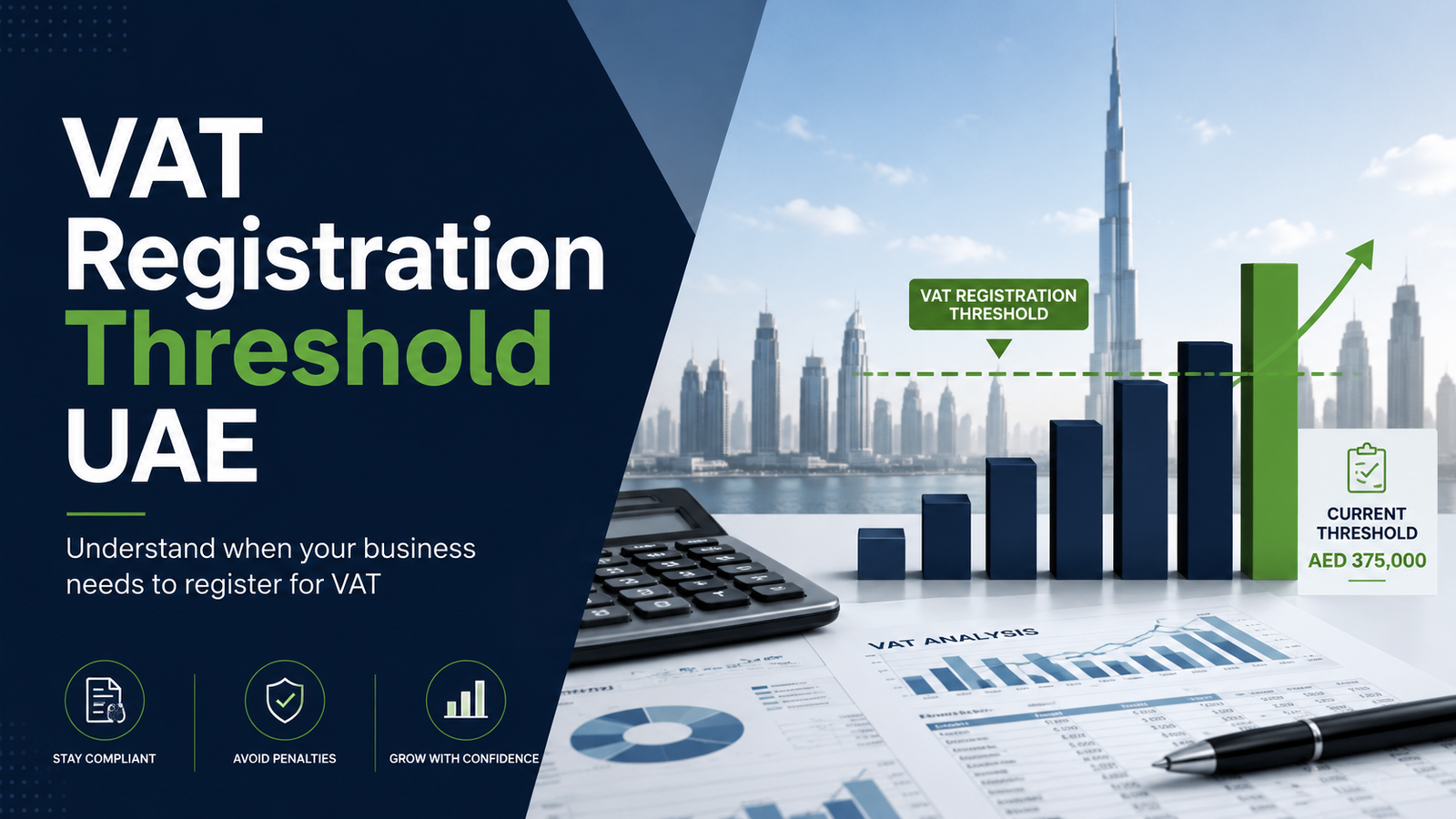
Under the standard regime, 0% applies to taxable income up to AED 375,000, while 9% applies only to the portion exceeding AED 375,000. These are taxable-income bands, not revenue thresholds.
For example, assume taxable income of AED 600,000, with no Small Business Relief election, special regime or tax credits:
Small Business Relief
Eligible resident persons can elect to be treated as having no taxable income where revenue does not exceed AED 3 million in the relevant and all previous tax periods. Qualifying Free Zone Persons and constituent companies of multinational enterprise groups meeting the definition in Cabinet Resolution No. 44 of 2020 are excluded. The relevant consolidated group-revenue threshold is AED 3.15 billion or more.
On 7 August 2026, the Ministry of Finance announced an extension to tax periods ending on or before 31 December 2029, replacing the original 2026 end date. The AED 3 million revenue threshold remains unchanged.
For example, assume an eligible resident company has revenue of AED 2.5 million and would have taxable income of AED 600,000 before Small Business Relief. Under the standard regime, with no other reliefs or tax credits, its Corporate Tax would be AED 20,250. A valid Small Business Relief election would instead treat it as having no taxable income for that period.
Relief is elected through the return, not granted automatically. Registration, filing and supporting records remain necessary. Review earlier periods: falling below AED 3 million after exceeding it in a previous tax period does not restore eligibility.
Large Multinational Groups
The Domestic Minimum Top-up Tax applies from financial years starting on or after 1 January 2025 to in-scope multinational groups with consolidated global revenue of €750 million or more in at least two of the preceding four financial years. Such groups need an assessment beyond the standard 0%/9% calculation.
UAE Corporate Tax for Free Zone Companies
A Qualifying Free Zone Person (QFZP) benefits from 0% on Qualifying Income and 9% on taxable income that is not Qualifying Income. The AED 375,000 zero-rate band does not apply to that non-qualifying taxable income.
Conditions include adequate substance, Qualifying Income, arm’s-length pricing, applicable transfer-pricing documentation and audited financial statements. A QFZP must not have elected into the standard Corporate Tax regime; that election is not an option to exit taxation altogether.
The de minimis test limits non-qualifying revenue to the lower of 5% of total revenue or AED 5 million, calculated under the applicable rules and exclusions. Failing the conditions generally removes QFZP status for the affected period and the following four periods.
Non-qualifying revenue used in the de minimis test is not the same as non-qualifying taxable income. Certain other income can be treated as Qualifying Income when the test and all other relevant conditions are met, while specified categories remain subject to separate rules.
Assess activities, customers and income streams individually. A licence description alone is insufficient evidence that all receipts qualify. Maintain a documented revenue analysis and review eligibility before adding activities or changing contractual arrangements.
Compliance and Filing Requirements
Registration
Check your registration deadline separately from the return deadline. Confirm the legal entity, licence details and tax period before applying through EmaraTax. A nil tax calculation does not automatically remove registration obligations. Our Corporate Tax registration services provide support with the applicable process.
Record-Keeping
Article 56 requires relevant Corporate Tax records to be retained for seven years after the tax period ends. Exempt persons must also retain evidence supporting their status.
Keep financial statements, reconciliations, tax-adjustment schedules, relevant related-party records and supporting invoices or contracts. These are practical examples, not an exhaustive checklist. Preserve access when changing software or accountants.
Tax Filing
Prepare the tax computation from reviewed accounts and reconcile the return to its supporting schedules. Complete applicable related-party and connected-person disclosures.
Maintaining transfer-pricing master and local files is distinct from return disclosure: the files are required where the prescribed conditions apply and are submitted when requested, rather than automatically attached by every business. Agree preparation and review responsibilities before Corporate Tax return filing.
Tax Payment
Pay the Corporate Tax due by the applicable deadline and retain payment evidence. Penalties differ by violation; there is no universal AED 10,000 ceiling. Late registration, filing, payment and record-keeping failures have separate consequences. Check the current penalty schedule rather than relying on a single quoted amount.
Filing Deadlines
Article 53 governs return filing; Article 48 governs payment. Both ordinarily require action within nine months after the relevant tax period ends, subject to applicable FTA directions.
For example, a tax period ending 31 December 2025 has a filing and payment deadline of 30 September 2026. Do not apply that date to every business regardless of year-end.
Work backwards: confirm status and deadlines, finalise accounts, assess adjustments and reliefs, obtain approval, file, pay and archive evidence. Assign an owner to outstanding documents rather than discovering gaps immediately before submission.
Closing
Reliable UAE Corporate Tax compliance starts with identifying the correct taxpayer and regime—not applying 9% to every business receipt. Keep records current and obtain qualified tax advice for exemptions, cross-border transactions and free-zone eligibility.
Contact Virtual Accountants LLC with your entity type, mainland or free-zone status, financial year-end and required service to discuss an appropriate scope of Corporate Tax support.
Let Virtual Accountants LLC handle the numbers—so you can focus on what you do best: growing your business.